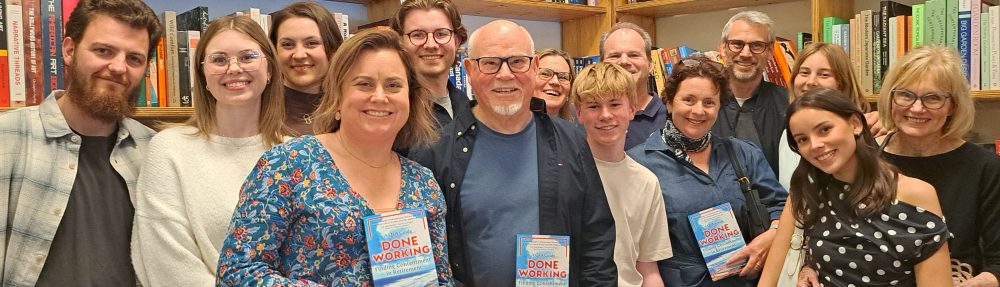
I’m excited to announce my latest non-fiction book DONE WORKING: Finding Contentment in Retirement will be published on 15 August 2026.
To celebrate this publication of my seventh book, there will be two launches in Brisbane: at Avid Reader Bookshop, West End on that day and then across town at Riverbend Books, Bulimba on 30 August.
In DONE WORKING, I’ve woven together the real-life advice of 101 retirees, world-wide research and my own experience with humour and insight to tease out seven ways of finding contentment in retirement.
The theme was triggered by a comment from a student in a University of the Third Age (U3A) class, who said, ‘I’m retired and busy, but I’m not contented.’
The book will appeal to anyone heading towards retirement as well as those already retired, and help them negotiate their own best way to a contented life.
Clinical Psychologist and Wellbeing Specialist Dr John Barletta said: ‘Dymock speaks a language we can all understand. This book puts you in the driver’s seat to develop a good life, simple as that.’
INVITATION
If you’re in or around Brisbane, you’d be very welcome at one of the launches. Check the bookshops’ websites for details:
Avid Reader, 193 Boundary Street, West End at 2.30pm Saturday 15 August 2026
There is no charge for entry to either event – tickets are free, but please book online to register. No obligation to order a book when you register for the launch.
If you can’t get to one of the launches, you can still order the book through either bookshop if you’d like a copy.
Outside of Brisbane, you or your local bookshop can order a copy through Avid Reader. It will also shortly be available as an e-book.
With best wishes for a contented retirement, wherever you are on life’s journey,
I never met a bookshop I didn’t like. I particularly love the quirky ones, with nooks and crannies, comfy chairs, tables, mirrors, the occasional dog. Those dispensing coffee get double stars.
I”m talking about real bookshops. Not those totally online international hussies that parade their wares like ladies of the night, and are basically committed not to literature but to making money.
Sure, real bookshops are businesses too, and they need to survive financially, but when you walk through their doors you can feel an ambience, inhale a bookish ‘smell’, that no online purveyor can hope to replicate.
This is especially true of independent bookstores, where the owner is often behind the counter. I’m not bagging the franchised chains here (I shop there too, and know they have dedicated staff), just admiring the gritty guts of those bookshop people who choose to do it for a living (or not).
Whenever I travel, I look for independent bookstores and usually buy a book to celebrate my visit, a tiny contribution to fostering their continued success. Every one of them is different, but they share a common feel of compressed creativity, a colourful pandora’s box of treasures waiting to be discovered.
They usually have a dedicated following too. In July 2025, the 103-year-old Hill of Content bookshop in Melbourne’s CBD recruited hundreds of volunteers in a human chain to transfer their stock of 17,000 books to a new location nearby after their building was sold.
Depending on your tastes, there might also be some occasional dross, where the contents don’t live up to the back-cover hype, but it can still be fun looking. Besides, as a writer I admire anyone who’s managed to convince both a publisher and a bookseller that someone might want to read what they’ve sweated over for so long.
For me the appeal of the ‘real’ bookshop over the online one is the chance to pull out a book from the shelf, read the cover blurb, flick through the pages, check the font size, feel the texture of the book between my fingers. Even the weight of a book tells me something. Then I might clasp it as a ‘possible’ while continuing to wander the shelves, hoping I can remember where it came from if I decide to put it back.
In 2020, in the middle of the Covid-19 pandemic, I recorded four interviews for an invited blog for Margaret River Press, Western Australia. It was a tough time for booksellers, and Fiona Stager, co-owner of Avid Reader Bookshop in Brisbane’s West End, told me in May that year, ‘If we have a good Christmas, we will all make it.’
Avid Reader Bookshop, West End, Brisbane
Five years later Avid Reader is not only still going strong, but Fiona and her partner have taken over Riverbend Books in Bulimba, on the other side of Brisbane.
Riverbend Books was formerly owned by another stalwart of the Brisbane literary scene, Suzy Wilson. She and Fiona are long-time supporters of the Indigenous Literacy Foundation, whose programs focus on instilling a love of reading at an early age in some 400 Aboriginal and Torres Strait Islander remote communities across Australia.
Both stores not only sponsor book launches, but also author talks, ‘crafternoons’, trivia nights, book clubs and various other literary events that take ‘reader engagement’ to a new level. Avid Reader has a spin-off store next door for younger readers: Where the Wild Things Are, a name taken from the outrageously successful children’s book by Maurice Sendak.
Despite my passion for ‘real’ bookshops, as both a writer and reader of books I’m grateful that there are digital options available for authors to publish and readers to access books. According to a recent article in the Sydney Morning Herald ‘Weekend Magazine’, more than half of Australians aged between 15 and 34 read e-books and almost one in three Australians listen to audiobooks.[1]
A younger friend of mine recently returned a non-fiction book I’d lent her (not one I’d written), apologising that she was out of practice with hard copy because she was used to ‘reading’ via an online app and a set of headphones.
I’m thankful that we still have in Australia what publishing agent Jane Novak called (in that same SMH article ) ‘a very healthy bookshop ecosystem’ (including second-hand bookstores, a genre in themselves). ‘Plenty of people thought e-books were bad for book sales,’ she said, ‘but they haven’t impacted the sales of hard-cover books in the way we thought.’
Let’s hope the market can continue to support independent bookshops like Avid Reader and Riverbend Books, not only because they provide a hands-on experience for readers, but also because they help sustain the culture of thriving local communities.
[1] Greg Callaghan, ‘The final chapter?’, SMH Weekend Magazine, 5 July, 2025, pp. 9-11.
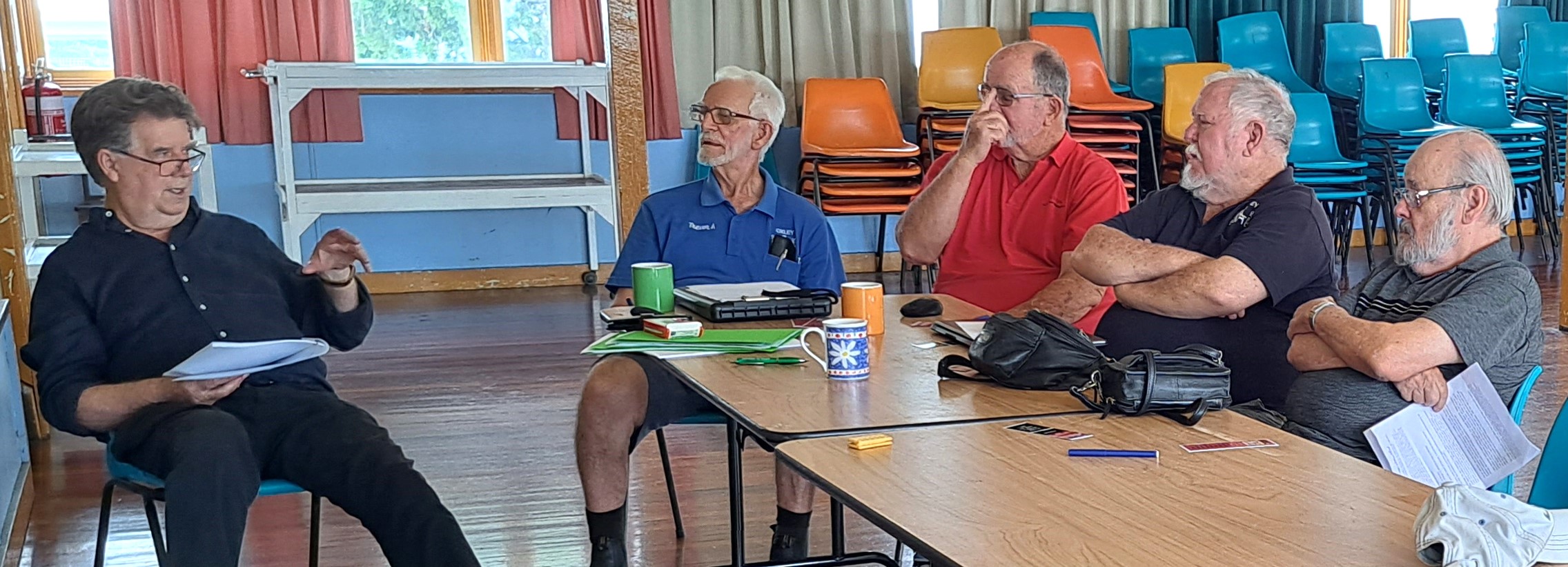
Peter Long with some of the Oxley Men’s Shed writers on his recent visit
Peter has worked as a stockman, public servant, consultant, researcher and academic, and is the author of two novels: Steve Hart: the Last Kelly Standing, and Identity: Larry Cummins, Bushranger.
In Steve Hart: The Last Kelly Standing, Peter takes a legend from the life of the (in)famous Kelly Gang and weaves it into a very creative novel.
Identity: Larry Cummins, Bushrangeris an intriguing fiction-based-on-fact exploration of the life of Peter Long’s great-grandfather, a not always successful bushranger who lived two lives, in two different states.
In addition to his novels, Peter has been successful in poetry and short story competitions.
So it was great that Peter could share his experience and tips with the Men’s Shed Writers Group, which is off to a strong start in 2024, the beginning of its fourth year.
All of the regulars have produced many life stories, with one member now past the 50 mark. Last year we were joined by a bush poet, and one of our newcomers is gearing up to share his first story with us. When we started, many in the group hadn’t written life stories before.
The good thing about this enthusiastic writing group is that as we share our stories every fortnight we also encourage each other in our writing. Peter Long’s talk gave us another stimulus to keep us going.
I’m Convenor of the Oxley Men’s Shed Writers Group, so feel free to contact me through the comment button on this page if you want any further information.