China’s one-child policy and why older people can’t find work

Regular readers of this column will know that I recently wrote a book about working into later life, Extending your use-by date. Strange as it may seem, the theme of the book is linked to a recent change of policy in China. That country’s government has recently announced the end of its controversial one-child policy. Couples will now be allowed to have two children.

The reason for the Chinese Government’s reversal of policy is not a sudden concern to meet parents’ wishes, but because it has finally realised it needs to do something drastic to address the ageing of the population and the lack of young people coming through to replace them in the workforce.

One child policy

This is not a problem only for China.  According to the United Nations, the proportion of the world’s population aged 60 years or over was 12 per cent in 2013, and is expected to reach 21 per cent in 2050. The spread is uneven, however, with the least developed nations less affected.

Examples from developing economies include: Singapore: by 2030, one in five citizens is likely to be 65 and above as compared to one in nine in 2015; UK: in the next five years, the total population is forecast to rise by 3%, but the numbers aged over 65 are expected to increase by 12%; USA: by 2060, the numbers of older people is forecast to reach about 98 million older persons, more than twice their number in 2013.

Adult students in a computer lab

In Australia, the proportion of Australians over the age of 65 is around 13%. In the next 40 years or so that figure is expected to almost double to about a quarter of the population – around eight million people. At the same time, the birth rate is declining.

For China and Australia and other developed countries, one issue is that there will be fewer people in the workforce, which has implications for both maintaining productivity and for the amount of revenue raised through taxation.

An ageing population will also potentially place heavier demands on health services and, in countries that provide government pensions for their citizens, on the welfare budget.

That is why some countries, including Australia, the UK, and France, have announced an increase in the retirement age, i.e. the age at which such a pension becomes payable.

Keeping older people in the workforce is therefore arguably something to aim for, especially as people are now living longer, and hence potentially capable of continuing to work.

The potential benefits are that the level of productivity is maintained, taxes are still being collected, and older workers have more money in their pockets, and are arguably more content with their lot. I say ‘arguably’ because some people hate their jobs or have health issues and just can’t wait to retire.

OW job ads

Here there comes the hitch, the fly in the ointment, the snag, the unexpected obstacle: age discrimination.

In the same week that China announced the repeal of its one-child policy, an Australian report revealed that a Government scheme to encourage employers to take on older workers had been a flop.

Introduced in 2014, the Restart scheme offered employers $10,000 over two years to employ people over 50, who had been unemployed and on income support for at least six months. The intention was to jack up the Australian mature-age workforce by 32,000 every year but, according to the New Daily, the actual number was 2318, around 7% of the target.

The $ amount was never enough to entice employers over a two-year period, and from November 1 the Government has reduced the period to 12 months, but not increased the figure to employers.

The real stumbling block, however, is not the money, it’s employer (and social) attitudes. Older people consistently find it difficult if not impossible, to be re-employed after leaving work voluntarily or through a redundancy.

This is despite the mounting evidence that people are capable of learning and training into older age, and that they have built up skills and knowledge that can contribute significantly to an organisation’s well-being.

This is not an issue only in Australia. The Huffington Post reported that a Georgia Institute of Technology review of the U.S. government’s 2014 Displaced Worker Survey found that someone 50 years or older is likely to be unemployed for almost six weeks longer than someone between the ages of 30 and 49, and close to eleven weeks longer than people between the ages of 20 and 29.

The study also discovered that the odds of being re-employed decrease by 2.6 percent for each one-year increase in age.

In Australia, the Human Rights Commission found that more than a quarter of 2000 workers surveyed said they had been discriminated against because of their age.

So, although the workforce is ageing, older people are living longer (and staying heathier too), and the proportion of younger people is declining, it’s still tough for older people to get back into work once they’ve left it, because of employer and societal attitudes.

The big question is: will those attitudes change in the face of a changing population age profile, and of the potential for productivity and hence the standard of living to drop because those older workers who want to work are being denied the opportunity?

Until next time

Darryl Dymock

What writers say:

Don’t try to figure out what other people want to hear from you; figure out what you have to say. It’s the one and only thing you have to offer. ~ Barbara Kingsolver
Until you know what it is to be a pea …

peas

And the winners are…

The Queensland Writers Centre and the publisher, Hachette Australia, recently announced the successful applicants for their 2015 joint Manuscript Development Program, now in its ninth year. They are:

Patricia Holland’s literary fiction manuscript ‘Lochwall’ (QLD)
Victoria Carless’ literary fiction manuscript, ‘The Dream Walker’ (QLD)
Wendy Davies’ romance manuscript, ‘The Drover’s Rest’ (VIC)
Susan Pearson’s historical crime thriller manuscript, ‘River is a Strong Brown God’ (QLD)
Mary-Ellen Stringer’s contemporary literary fiction manuscript, ‘A Beggar’s Garden’ (QLD)
Angella Whitton’s contemporary fiction manuscript, ‘The Night River’ (NSW)
Kali Napier’s historical fiction manuscript, ‘The Songs of All Poets’ (QLD)
Susan Fox’s commercial women’s fiction manuscript, ‘Mine’ (VIC)
Imbi Neeme’s divorce lit manuscript, ‘The Hidden Drawer’ (VIC).

I remember the excitement I felt when my name appeared on that list in 2010 for my non-fiction manuscript of the story of the Australian trail-blazing aviator, Bert Hinkler, which was published by Hachette Australia three years later as Hustling Hinkler. I also remember the anxiety I felt as I realised I had to polish my work to the highest standard for publication, and then submit it to public scrutiny.

Dawn Barker's book, 'Fractured', was chosen for the Manuscript Development Workshop in 2010, and later published by Hachette

Dawn Barker’s book, ‘Fractured’, was chosen for the Manuscript Development Program in 2010, and later published by Hachette.

From the experience of writers selected for the Manuscript Development Program in the past, not all the authors on the list above will see their books published by Hachette. Some will go on to other publishers; some may not make it to the point of publication, for various reasons.

Whatever the final outcome, selection in itself is an acknowledgment that the writer stands out from the crowd, and has something special to offer. So that alone is an encouragement in an industry where ‘getting a start’ is tough.

I know a writer whose application was unsuccessful this year, and I know how much work she put into the manuscript and how she drew on professional advice to help her shape her story. Even though she missed out on selection, this author is not giving up – she has a back-up plan to seek publication in other ways.

Some of the readers of this blog will know that one of my favourite quotes about writing is from the late science-fiction author, Isaac Asimov:

‘You must keep sending work out; you must never let a manuscript do nothing but eat its head off in a drawer. You send that work out again and again, while you’re working on another one. If you have talent, you will receive some measure of success – but only if you persist.’ Isaac_Asimov

Read, and think, and listen to silence

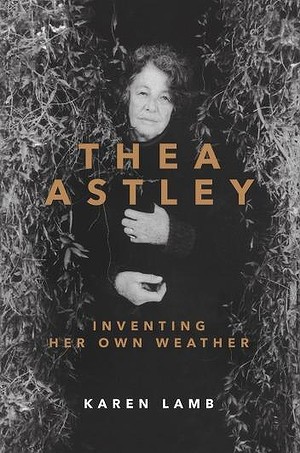
I’ve been reading a biography of an author who won four Miles Franklin Awards*: Thea Astley: Inventing her own weather by Karen Lamb (University of Queensland Press, 2015), and came across this advice from the distinguished Australian author, Patrick White (1912 -1990), to Astley in 1961:

‘I think you should write nothing for a bit. Read. … Read, and think, and listen to silence, shell the peas, not racing to begin the next chapter, but concentrating on the work in had until you know what it is to be a pea … Then, when you have become solid, you will write the kind of book you ought to write.’ (p. 137)

Fire on the horizon

I was recently in Adelaide, South Australia, taking to ex-Chalkies about Army Education in Papua New Guinea (see previous blogs) and couldn’t resist taking this pic of the jetty at Glenelg around 8 o’clock on a Saturday night.

Glenelg Jetty Adelaide 8pm in mid-October

Until next time

Darryl Dymock

*The Miles Franklin Award award, now worth AU$50,000, was bequeathed by the will of Australian novelist, Miles Franklin, for a ‘published novel or play portraying Australian life in any of its phases’.  All entries for the award must have been published in the previous calendar year.

Input vs Output for Writers

The Brisbane Writers Festival (BWF 2015) is over for another year. I was fortunate to be able to get to a couple of the sessions on the Thursday and Friday – a masterclass withBWF-2015 US short story writer, Kelly Link, and another with researcher and biographer, Karen Lamb.
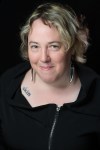
Kelly Link introduced us to The Family Arcana: A Story in Cards by Jedediah Berry. It’s described as ‘a story about a haunted family, published as a poker deck and written to be read an infinite number of ways’. Kelly’s deftness in shuffling this pack indicated either that she spent her childhood in Las Vegas or that she has a fall-back position if she ever tires of writing. One member of the masterclass asked her about the appropriate length of a short story. Kelly said she’d recently written a 14,000-word story, and one of her writing colleagues consequently suggested it

Author Kelly Link

Author Kelly Link

was time she thought about writing a novel…

I bought a copy of Kelly’s latest book of short stories, Get in trouble (Text Publishing, 2015), and when she signed it she warned me that the stories had ‘pretty weird endings’. I’m looking forward to reading it.

I have a few things in common with Karen Lamb – she’s a researcher and biographer, she teaches at a university in Brisbane, and she likes structure in her teaching. So she had a timetable for the masterclass. The value of the class for me was that it gave me new insights into my current draft about the ‘Chalkies’ in Papua New Guinea 1966-73 (see previous blog). Also, Karen mentioned a book by an American writer, the intriguingly named Francine Prose, Reading Like a Writer (Harper Collins, 2006), described as ‘A guide for people who love books and for those who want to write them’, which could be worth a look. I bought a copy of Karen’s biography, Thea Astley: Inventing her own weather (University of Queensland Press, 2015), because I’m interested to see how she wrote it, and I also like supporting fellow writers as well as an independent bookshop (State Library of Queensland).Thea Astley biog

There were other potentially fascinating sessions at BWF, but apart from having family commitments over the weekend, I also reach a point at such events where I need to get back to my own writing rather than continue to hear other writers talk about theirs. I strongly support the adage that the best thing a writer can do is write! As a long-time educator as well as writer, I believe external input, whether through writers’ festivals, self-help guides or online tips, can be very helpful, especially if it’s timely, but it can also be an excuse for procrastination.

Book review

I thought I’d share with you my response to a book my wife gave me for my birthday: Between you and me: Confessions of a comma queen by Mary Norris (Text Publishing, Melbourne)

Mary Norris is a copy-editor at the well-known The New Yorker magazine, which publishes news stories, short stories, essays, cartoons, poetry, etc, and includes an audience well outside its host city. It’s also well-known, if not notorious, for its rigorous copy-editing, and Mary Norris is one of the enforcers.

new-yorker-magazine

This non-fiction book is part memoir, part discussion of points of punctuation and grammar, often humourously expressed, and sometimes self-deprecating. Nevertheless, there are clearly standards of English expression to be upheld, and Ms Norris shows she believes has a responsibility as a standard-bearer. She does not brook the use of dangling participles, for example, once objecting to this construction from an author: ‘Over tea in the greenhouse, her mood turned dark’, and she rejects outright the use of ‘their’ in place of ‘his and/or her’. Mary Norris also uses only No. 2 pencils for hard-copy editing and if someone accidentally leaves a No. 1 pencil on her desk and she picks it up, she knows immediately it is not hers, and throws it in her desk drawer.  Part of her story is about being able to find a reliable supply of No. 2 pencils.  You get the picture.

In between, the author gives us a fascinating insight into the backrooms of The New Yorker and her fellow editors, including Lu, who ‘patrolled the halls like a prison warden’. On Lu’s desk sat a small canister she called a ‘comma shaker’, to express her distaste for what she saw as The New Yorker’s over-use of commas.

Between you and me: Confessions of a comma queen is an enjoyable read, and some of Mary Norris’s punctuation examples are guaranteed to provoke discussion among people who care about the use of language. I just hope she doesn’t run her No. 2 pencil over my blog.

Until next time

Darryl Dymock


A bumper restart blog

Good intentions

There’s an old saying that the road to hell is paved with good intentions. The lack of activity on my blog in recent times has not been due to lack of intention but rather, lack of time. This has been a busy year, including a period spent in the UK, Finland, Sweden and Norway, as well as a short teaching stint in Singapore. Since I believe writers shouldn’t procrastinate, however, I’m determined to restore my regular blog and to let those generous people who were following it know that I have not neglected my writing since I last posted here. So here’s a bumper blog for the restart.

With Assoc Prof Sarojni Choy and Singapore students July 2015

With Assoc Prof Sarojni Choy and Singapore students July 2015

Conscripted!

Imagine that you’ve completed your teacher training in an Australian state or territory, and have just spent your first full year in front of a class. The next year, without your willing consent, but with the full force of the law, you’re in the Army. If you’re lucky, you may still be teaching, but not in a school, and not in Australia…

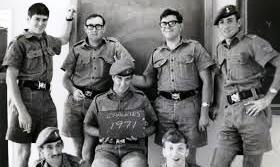
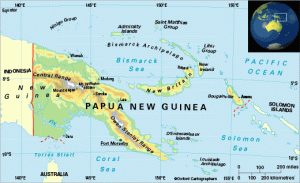
From 1965 to 1973, during the Vietnam War period, almost 64,000 young Australian men were conscripted by ballot into a two-year term of ‘National Service’ with the Australian Army. Over 15,000 of these conscripts were sent to assist the American war effort in Vietnam, but some 300 National Servicemen, who had been school teachers before their call-up, were quietly posted with the Royal Australian Army Educational Corps to the then Territory of Papua New Guinea for roughly 12-month periods. Colloquially known as ‘Chalkies’, the conscripted teachers served in the 3000-strong Pacific Islands Regiment, assisting an Australian Government effort to prepare TPNG for self-government and eventually independence.

Chalkies in Territory of Papua New Guinea

Chalkies in Territory of Papua New Guinea 1971

With the aid of an Australian Government Army History Research Grant and a small reference group of ex-Chalkies, I’m currently writing the history of that scheme, drawing on official records (ask me about the frustrations of archival research sometime, when you have an hour or two to spare), historical commentaries, and more recently, the responses of more than 70 ex-Chalkies to a national survey. This is a little-known story, and the recollections of those teachers provide a fascinating picture of young men suddenly catapulted from their school classrooms into the military, of how they survived the experience, and what it meant to them.

I presented a paper about this scheme at an international adult education conference in the UK in July, and am aiming to develop the fuller material into a non-fiction book. As a writer, I’m enjoying the challenge of capturing the diversity of stories, not to mention the humour and sometimes the pathos of individual experiences. Remarkable stories in unique circumstances.

Writers group

I’ve been meeting every few months with three other writers as a spin-off from a very successful workshop I ran for the Queensland Writers Centre in 2014, ‘Harnessing research for writing’. The four of us discuss our work and read from it, and at the last meeting we also shared our thoughts on a favourite or impactful* book.

To protect their privacy, I won’t mention the other members by name, but they have also been developing their writing: one has finished a novel based on true events in Asia and Australia, and is seeking publication; another has found a satisfying online outlet for his writing, which is based on his particular professional expertise; and the other member of the group is researching a 19th century soldier with American origins and an Australian demise, with the intention of writing a biography. It’s a very supportive and productive group.

*Hand up if you think this is a real word.

Baffled by Baffle Creek?

If you’ve never heard of Baffle Creek, that’s understandable, especially if you don’t come from the mid-coast of Queensland. I hadn’t heard of it either until Kevin Sommerfeld contacted me to see if I’d be interested in writing a history of the Baffle, as it’s known locally. My name had been suggested to him by Lex Rowland OAM, who chairs the Board of the Hinkler Hall of Aviation in the coastal city of Bundaberg, where Lex ‘launched’ my book, Hustling Hinkler, a little while back.

Baffle Creek, which is more like a river, empties into the sea just north of Bundaberg,

Baffle Creek

Baffle Creek

and Kevin grew up in that area.  He’s been assembling historical material for some years,but felt he needed some assistance to write the story. After meeting with Kevin, who lives about an hour’s drive from my place in Brisbane, Queensland, we agreed that I would take the lead in using the material he had collected to write a jointly-authored article for the Queensland History Journal. It was a lot of work, but we beavered away, and the result is a 6000-word peer-reviewed article, ‘Baffle Creek: the changing fortunes of an inland waterway’, which was published in the August 2015 edition of that journal. Kevin and I patted each other on the back via telephone.

Lifelong learning

In case you haven’t noticed, I’m a strong proponent of lifelong learning (e.g. see my book, Extending your use-by date, and the Griffith Review essay, ‘Working late’), and am currently co-editing a book, Supporting learning across working life: Models, processes and practices, which will be published by the international academic publisher, Springer, later this year.  I’m also contributing as an author to three chapters in that publication.

Finally…
I believe in that adage that writers should also be readers, and read on average a book a week.  Just in case you think from what I’ve written above that I’m only into non-fiction, much of my recreational reading is crime novels and thrillers, and an occasional historical novel. I’m also working on a fiction novel and a couple of short stories, all based on real-life events.

What are you reading at the moment?

Darryl Dymock

Making a difference

I’ve never been one for making New Year resolutions, or rather, specific New Year resolutions, but at the beginning of each year I always feel an urge to do better in some way. (Mind you, the fact that I ‘m writing this on the first day of February might indicate that overcoming procrastination could be a specific goal worth aiming for.)

While I was doing a clean-up of my study over the past few weeks (which in itself might be seen as appropriately New Yearish), I came across two clippings, that, on re-reading, seem particularly appropriate for beginning a new year.

One of them is an extract from Ray Bradbury’s classic story, Fahrenheit 451:

“Everyone must leave something behind when he dies, my grandfather said. A child or a book or a painting or a house or a wall or a pair of shoes made. Or a garden planted. Something your hand touched some way so your soul has somewhere to go when you die, and when people look at that tree or flower you planted, you’re there. It doesn’t matter what you do, he said, so long as you change something from the way it was before you touched it, into something that’s like you after you take your hands away. The difference between the man who just cuts lawns and a real gardener is the touching, he said. The lawn-cutter might just as well not have been there at all; the gardener will be there a lifetime.” (HarperCollins, London, 2004, p.164) In everything that I do, I’d rather be the gardener than the guy who just cuts the lawn.  I think of my late sister-in-law, Monica, who was about the same age as me when she died 18 months ago, and how her memory still lives on in the lives of people she knew and loved, because she touched them in some way. Through her acts and words, and through her husband, children and grandchildren, she’s still there.
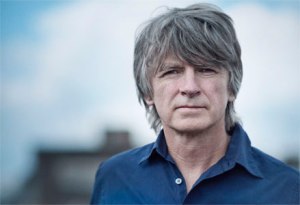
The other quote I came across is from Neil Finn, former member of the band ‘Crowded House’, who continues to perform. Talking about his song-writing in an interview published in the Sydney Morning Herald, Finn said:

“When something looks effortless, like it always existed, like it rolled out of you like a river, then you have done a good job. But what makes that up is painful, small steps, craft, skulduggery, anything that gets you over the line.”

Neil Finn

Neil Finn

I have a number of writing projects on the go this year, and my aim is to make all of my writing look ‘effortless’. But I know that will require ‘painful, small steps and craft’ and that magic ingredient Finn calls ‘skulduggery’. There is also another element, which he doesn’t mention: just getting on with it. Sit down and write.

For 2015, may your gardens be well tended and your creativity roll out of you like a river. “It doesn’t matter what you do, so long as you change something from the way it was before you touched it, into something that’s like you after you take your hands away.”

How would you like to be remembered?

Darryl Dymock

What’s a chalkie?

If a carpenter is a ‘chippy’ and an electrician is a ‘sparky’, what’s a ‘chalkie’? It’s a slang term for a teacher, and comes of course from the days when chalk and blackboards were the only teaching aids in a school classroom.

I’ve recently started doing some research and writing about a very special group of chalkies – conscripted Australian teachers in the Vietnam War era who were posted to the then Territory of Papua and New Guinea (TPNG) as part of the Army’s contribution to the education of indigenous soldiers of the Pacific Islands Regiment. The selected teachers became members of the Royal Australian Army Educational Corps, and my later doctoral thesis was about the corp’s predecessors in the two world wars.

Between 1966 and 1972 (the year conscription was abolished), more than 300 young men (average age about 20) who’d been plucked from schools across the nation when their birthdate marble was pulled from the Australian government’s barrel, spent the second of their two-year ‘national service’ in Army bases in TPNG, teaching mainly English, Maths and Civics. I was one of them, and am enjoying the opportunity now to make sense of a relatively small but significant part of my life more than 40 years ago.

A small grant from the Australian Army History Research Unit is helping to support the research, and I have recruited a willing group of ex-chalkies as a ‘reference group’: Norm Hunter, Ian Ogston, Greg Farr, Greg Ivey and Terry Edwinsmith,  shown with me in the accompanying photo. Even before my project, a number of these enthusiasts had set up a great website to document some of the stories, and quite a few have already contributed bits of history from the period to that site.

Chalkies Ref Group

Although we didn’t know it at the time, the period we were in TPNG was almost immediately before the coming of self-government and shortly thereafter the declaration of independence. So it’s a challenge to place the chalkies’ contribution in that broader context and as part of the Australian Army’s support for TPNG in the years we were there. As an historian and a writer, I’ve always liked a challenge like that.

Books from our backyard 2014

Both my books that were published in 2013 are in the Books from our backyard 2014 catalogue, developed and recently published by the Queensland Writers Centre. Books from our Backyard is a catalogue of books written by Queenslanders or Queensland residents and published in 2013. My two are:

Hustling Hinkler: The short tumultuous life of a trailblazing Australian aviator (Hachette Australia 2013). Available at good bookshops and online through Amazon, Dymocks etc.
Extending your Use-by Date: Why retirement age is only a number (Xoum 2013). Available in print and e-book from the publisher http://www.xoum.co.au and online though Amazon, iTunes etc.

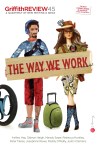
My latest published piece is ‘Working late: Encore careers’, an essay published in Griffith Review literary magazine, No. 45. As a result of that article, I was interviewed on Tony Delroy’s Nightlife program on ABC Radio on 30 July, along with another contributor to that issue of Griffith Review, Gideon Haigh.


How much culture is enough?

I went to GOMA today – the Gallery of Modern Art, in Brisbane. It didn’t have one of its blockbuster displays, but every so often I find I need an input of Culture, perhaps to offset the outputting I do when I’m writing. And for the past few weeks I’ve been trying to finish the first draft of my next narrative non-fiction manuscript. Working title? Still a secret. No, that’s not the working title; what I mean is that I haven’t made up my mind and/or I want the title to be a surprise when (if) it hits the bookshops. Besides the (potential) publisher might want to change it. Watch this space.

20140706_145438 (2)

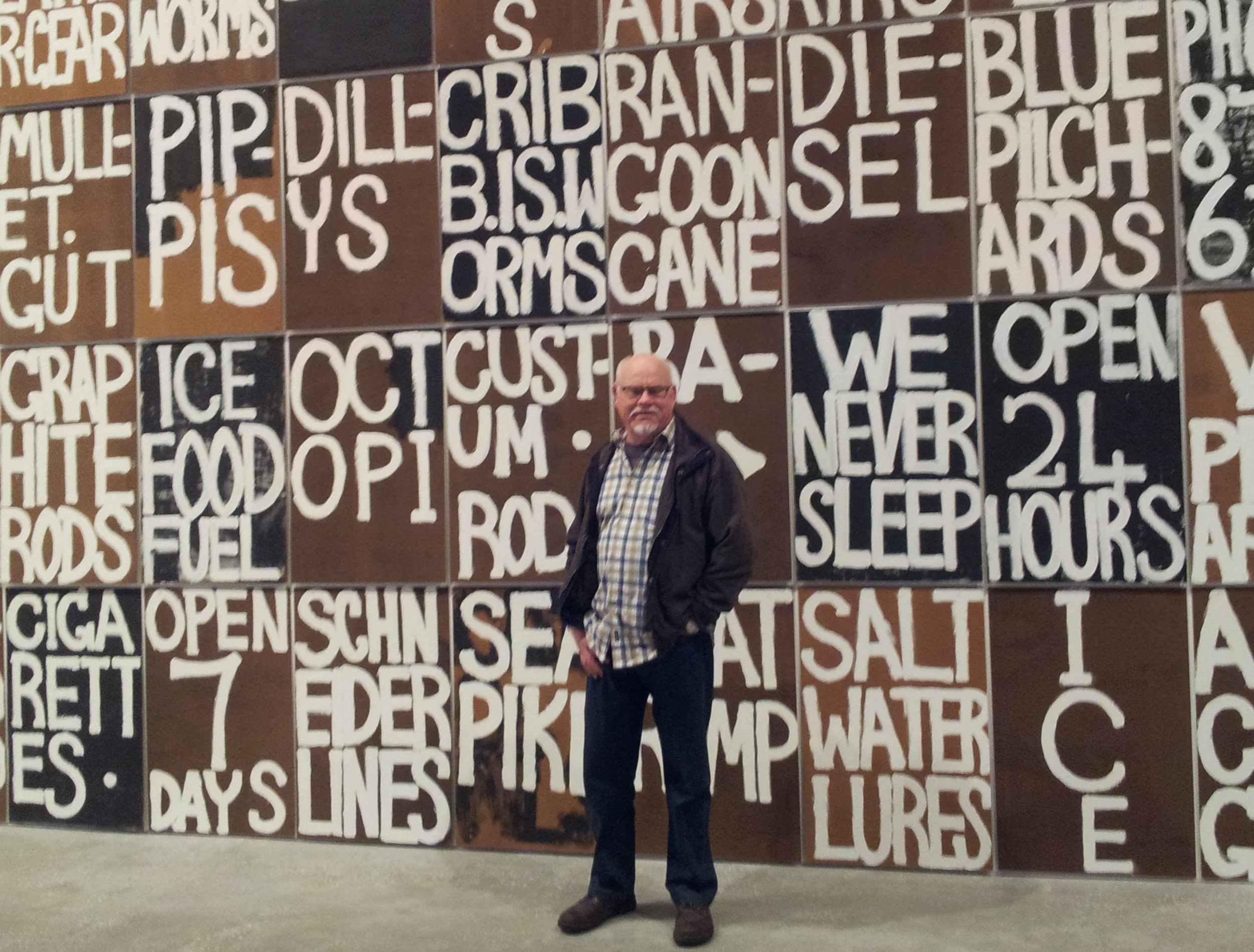
Anyhow, here are a couple of pics of me at GOMA, one with a moover and shaker (sorry, couldn’t resist that), made from empty beef tins, and one in front of a clever bit of work by Robert MacPherson that he dedicates to a group of fisherman known as the ‘Swamp Rats’. Note how some of the words on the signs slide down to the next line, as if he ran out of room.

Earlier in the week I attended the launch of Books From Our Backyard, an initiative of the Queensland Writers Centre, with state government funding, to try to list all the books published the previous year that were written by Queenslanders or by authors resident in  that State. Commercial, self-published, e-books, all get a go. I’m fortunate to have two listings in the glossy catalogue: Hustling Hinkler, and Extending Your Use-By Date. More movers and shakers there, including author Nick Earls, but no cows.

I was pleased to see that my Perth-based friend Dawn Barker’s book, Let Her Go, has hit the bookshops, and no doubt will sell as well as her debut book last year, Fractured.  I picked up my copy of Let Her Go at Dymocks Bookshop Indooroopilly, a couple of suburbs away. Another writer friend, Charlotte Nash, will be at the Indooroopilly Library on 15 July to talk about her recently released book, Iron Junction.

My next piece of non-fiction (apart from my academic publications, which are constantly on the agenda) is an essay in the forthcoming issue of the literary magazine,Griffith Review, whose theme is ‘The way we work’. My article is called, ‘Working Late: creating encore careers’, which is a bit more laid back than the title of another article in the same issue, by Elizabeth Woods, ‘Fit in or f**k off’. Needless to say, there’s a range of fascinating and sometimes provocative articles. In my paper, I argue that as so-called Baby Boomers come to recognise their increasing longevity, and that that cognitive and physical decline for many is generally not as rapid as they feared, this large cohort of older people are increasingly looking for meaningful activities in the third age of life that will make use of their years of life and work experience. Which includes me.

That’s probably enough culture for now. Back to the manuscript.

Darryl Dymock

Hustling Hinkler (Hachette Australia) is available at or through good bookshops and online; Extending Your Use-by Date is available as an e-book or in a print edition from Xoum Publishing, Sydney.


Why are you writing?

I recently ran a workshop, ‘Harnessing your research for writing’, for the Queensland Writers Centre, and one of the most valuable sessions was when the 12 participants were asked to write a synopsis of the non-fiction book they were writing or planning to write. In 100-200 words, they tried to put down what the book is about, in words that would make a reader want to rush to open it, or a publisher offer a contract.

This turned out to be a challenging session for all of them. I watched them sweating over their keyboards and notebooks, grimacing, sitting back, crossing out, plunging on. At the end of the allotted time, I asked each of them to read out the first few sentences, and for the other to give feedback. It was a very constructive session, I thought, and its major value was in forcing all of them to consider what the purpose of the book was, what their intention was in writing it. Some of them were quite clear about where the book was heading, others were not so sure, and one or two decided they needed a major rethink.

It was a very interesting range of themes too, from memoir to self-help, and we plan to get together again in a couple of months to see how we’re all going.

If you’re writing a book, or planning to, you might consider the same exercise, writing a synopsis, as a way of focussing on its purpose, whether it’s fiction or non-fiction. It could be a helpful way of keeping your writing on track.

One person who’s been on track with her writing is Charlotte Nash. I recently went to the launch of Charlotte’s second rural romance novel, Iron Junction. Set in Western Australia’s Pilbara region, the book tells the story of Dr Beth Harding, who leaves Sydney to take a locum job in the mining town of Iron Junction, and Will Walker, who’s foregone following his father into the cattle business to work in the mines.

Hi-vis vests & hardhats at the Iron Junction launch

Hi-vis vests & hardhats at the Iron Junction launch

Once again the book draws on Charlotte’s experience in the bush as a medical trainee and engineer. At the launch, a bunch of creative friends came in high-vis vests and hard hats, complete with Iron Junction logo. Charlotte added to the creativity by giving away chocolate bars and bottles of waterWith Charlotte Nash Iron Junction launch adorned with a label from the book’s cover. Sustenance for the mind and body. Water and reading are non-fattening, but I have my doubts about the chocolate …

Writing with passion and purpose

When people learn that I’m a (mainly) non-fiction writer, they sometimes say, ‘I don’t know how you write a book. I wouldn’t know where to start.’

When it comes to non-fiction, you should start with the primary purpose of the book. Why are you writing it?

If it’s a memoir, are you writing it for yourself or for others to read? If it’s a history, what are the main themes you want to stress, i.e. what are the points you want to get across through the story you are telling? If it’s a self-help book, what messages do you want the reader to go away with, or what actions do you want them to take? And so on.

In the introduction to Speechless (Melbourne University Press, 2012) James Button writes:

I wrote this book because I feel an important issue is at stake. Our politics seem thin and barren. Ordinary people are increasingly uncomprehending and disengaged. … But this view, however understandable and widely felt, does not do justice to the many people I met in Canberra who are trying to do good things … On the inside, the stories of politics and government are as fascinating and vital as ever.

Whether or not you agree with his viewpoint, Button’s words go to the heart of any writing: the author’s passion for the subject, passion for the story, passion for the message. What is it that you are passionate about that you want to convey in your book?

Once you have decided on the main purpose of your writing, you need to deal with how best to sequence the material you want to present. If you’re writing a history or biography, it might seem a no-brainer that the events will be in chronological order, but that isn’t always so. You still need to engage the reader, and some information may better serve as background to the main events.

For example, in Jon Krakauer’s book about a disastrous series of accidents and misjudgements on Mount Everest in 1996, Into thin air (Pan Books, 2011), he lets us know in the Preface that twelve people died – we don’t need to wait for the final chapter for that piece of tragic news. He is counting on the reader wanting to know how such appalling loss of life came about. In addition, the first three chapters leap back and forth in time: May 10, 1996; 1852; and March 29, 1996, respectively. In Chapters 2 and 3, Krakauer explains how past events had an impact on the happenings he describes in Chapter 1.

You will also need to decide how to structure your information, e.g. in chapters around key events, by theme, or by topic. If you compare cook books, you will see that culinary authors use a variety of criteria to decide what they will include and how they will group and sequence it. Stephanie Alexander’s classic, The cook’s companion (Penguin, 1997), features recipes based around foods in alphabetical order, beginning with ‘Anchovies’, and ending with ‘Zucchini and squash’, but the opening sections are about ‘Equipment’ and ‘Basics’. The sections in Annabel Langbein’s The free range cook (ABC Books, 2012) on the other hand, start with ‘From the oven’ and conclude with ‘From the orchard’. The authors and publishers not only have a particular purpose in mind for each of those books, but also a particular audience, which is the third issue you need to consider: for whom are you writing?

The answer to that question will help you decide on both the content and sequence for your book.

If you’re writing a self-help book about computers, for instance, what level of expertise do you expect the readers to have to be able to make use of what you tell them? In the early days of home computers, an American professor of adult education, Malcolm Knowles, complained that manufacturers’ manuals were geared towards teaching buyers how a computer works rather than about using it to perform the real-life tasks people bought them for. The point he made is still an important one for non-fiction authors: consider what the end-user is likely to want the information for.

Even in memoir writing, you need to consider what your intended readers might be most interested in. Putting in everything you consider important may be boring to those not so intimately connected with your life events and activities.

Nevertheless, as Simon Nasht says in The last explorer, a biography of Hubert Wilkins, the sum of a person’s life is not measured just by its accomplishments, but by how it is spent. The challenge for an author is to present that life, whether it is their own or someone else’s, with a sense of purpose in the writing, and with the information ordered in a way that makes sense to the reader, while at the same time not overburdening the book with trivia.

Finally, you may want to supplement your text with images, and once again you need to consider what will be helpful to the reader. Can you imagine a cookbook without photographs to help you see what you are aiming for? A map will make clear an explorer’s path, drawings can transform a how-to book, a graph can provide an instant comparison of a bunch of statistics, and carefully selected images can illuminate a biography or memoir.

I’ll be leading a one-day workshop at the Queensland Writers Centre in Brisbane on Saturday May 3 on the topic of ‘Harnessing your research for writing’, and we’ll be working our way through all those elements of a non-fiction book.

It doesn’t matter where the participants are up to in the writing process – whether it’s still an idea in their heads, or whether they’ve assembled some research and have begun writing. At the end of the day, they should go away with a plan of how to put it all together in a way that will be attractive to readers.

This should be the perfect opportunity to kick off the project they’ve always been intending to do. 

If you can’t make it to the workshop, I hope the ideas above might stimulate you to begin or continue your own non-fiction writing journey.

What’s your passion and how do you or will you write about it? Whatever sort of writer you are, I’d love to hear from you via the Comments button on this page.

PS My ‘self help’ book, Extending your use-by date, is now also available in print format, from the publisher: Xoum Publications.