It’s raining books!

In my previous blog, I mentioned that I’d strategically placed books by three fellow authors when Channel 7 News was filming an interview in my home office. Within a couple of weeks of publishing that blog, I discovered the exciting news that all three of them have new books in the pipeline. I also have a small item to add about one of my books.

Charlotte Nash

First cab off the rank is Charlotte Nash, with Iron Junction, her rural romance follow-up to the best-selling Ryders Ridge.

This time the setting is on the other side of the continent, in isolated mining country in Western Australia. According to the Hachette website: ‘Overwhelmed by her family’s expectations, Dr Beth Harding leaves Sydney behind and takes a locum job in the mining town of Iron Junction. With tensions in the mine running high, and feeling like an outsider, Beth is soon convinced the move was a huge mistake. That is, until she meets Will, who could make the difference between her leaving or staying.’ You’ll have to buy the book to find out if she stays or goes…

Ryders Ridge will be launched in Brisbane on 11th April, and I plan to be there.

Dawn Barker

Just two months later, Dawn Barker’s new book, Let Her Go, will be released. This is also a second book, after the very successful Fractured. Dawn has used her experience as a psychiatrist in both these books, and Let Her Go is described as ‘a gripping, emotionally charged story of family, secrets and the complications of love. Part thriller, part mystery, it will stay with you long after you close the pages wondering: What would you have done?’
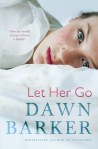
Watch for Let Her Go in bookshops in June/July.

Poppy Gee

To complete the trio, I bumped into Poppy Gee, author of the popular Bay of Fires, at the Launceston airport, where she was en route as an invited speaker at the inaugural Festival of Golden Words at Beaconsfield in northern Tasmania. Poppy told me that she’s finished her second novel, and that it’s currently with a publisher, so WATCH THIS SPACE.

Extending Your Use-by Date

Finally, my news is not as exciting as another book publication (although I am working on another narrative non-fiction), but I’m pleased that Extending Your Use-by Date, which was published as an e-book in 2013, is now also available in print format. I know some people who will be pleased to have a hard copy in their hands. It’s available through the publisher, Xoum Publications, Sydney.

Keeping up appearances

I have a spate of local author events coming up in the next two months. If you’re in the area, you might like to check these out:

 Monday April 7: The rocky road to publication.

Elanora Library, Gold Coast 10am-11am gold-coast

Robina Library, Gold Coast 2pm-3pm

This is part of the ‘Gold Coast Writes’ program, and  I hope that tips and discussion in these free sessions from my experience in researching, writing and getting publishing contracts will help prospective authors on their own writing journeys. Bookings here.

 Saturday May 3: One-day workshop: Harnessing research for writing

Queensland Writers Centre, Brisbane, 10.30am- 4.30pm.

‘Whether you’re writing biography or historical non-fiction, family history or instructional guides, the most daunting task is how to structure and present your research and resources in a logical way to create a compelling read.’ QWC

This workshop comes from my own experience over many years and from queries from other prospective non-fiction (and fiction) writers about the challenge of shaping the information you’ve collected into a manageable and logical sequence that will make sense to readers. This will be a hands-on workshop where writers can go away at the end of the day with a plan that they can implement immediately, wherever they are up to in the development of their manuscript, from beginner to almost completed.

 22 May: Panel Discussion: Australian Novels as History

Toowong Library, 6pm-7.30pm

This is a free event for Australian Library Week, and I’m delighted to be able to support a local library. My writing is mainly historical non-fiction, but I’m sure there will be opportunity for a few viewpoints.

As you can see from all the above, while the publishing process can often take a long time, sometimes things come together! So when you step outside, you’d better put your umbrella up quickly, but upside down of course, so you won’t miss any of these great books 🙂

Andy Warhol owes me 13 minutes

Andy Warhol

Andy Warhol

You no doubt know of that saying, attributed to the late Andy Warhol, that each of us will be world famous for 15 minutes in our lifetimes. For a moment recently, I thought I had a chance. But it didn’t last 15 minutes. And it wasn’t world-wide. Not even quite national.

It started one weekday morning on the physiotherapist’s couch, where George attached what looked like two chewing gum patches to my knee. The patches were connected to wires running back into a machine that apparently would send electrical impulses to do miraculous things to my patella. As George was telling me about it, I felt my heart flutter, and for a moment I thought he might’ve turned the machine up too high and given me a full charge.

Then I realised it was my mobile phone, vibrating in the pocket of my shirt, with the sound turned off. I didn’t want to interrupt George because he was telling me something important – the overnight test cricket score. As soon as he left me to tend to another patient, I whipped out my phone and found a message to ring the media office at Griffith University, where I work part-time. Channel 7 wanted to do an interview, something to do with my e-book, Extending your use-by date.

A short time later, when I had left the physio’s, Georgia rang from Channel 7, Melbourne. They were doing a story on a 97-year-old Ballarat man who was still working as a mechanic, she said, and wanted to widen it with some comments from me about people working into older age. No problem, I said. That’s what my book is about. Would it be okay if we send a Brisbane-based TV crew to your place around midday? Georgia asked. Sure, I said. Do you have an office where we might film an interview? No worries, I said. Then I rushed home to clean up my office.

The room I use as an office is a small bedroom in our modest house, and fortunately I was able to toss a lot of loose material behind the sliding wardrobe doors. Clearing the desk took a little longer – I’m one of those people whose creativity is fuelled by having stacks of papers and books all around me. (At least, that’s what I tell my wife, who seems to find the explanation highly amusing.) A quick flick with a dusting rag and I was ready for the camera crew. Almost.

The next question was what to wear. I was in my summer at-home working gear of shorts and  T-shirt. Too informal for an interview about my research. I looked through my long-sleeved shirts. Fine stripes and close checks tend to flutter or strobe on camera, and vivid white might send viewers rushing for their sunglasses. Fortunately, I like blue shirts, which TV also likes.

Dressed in what I hoped was a ‘smart casual’ outfit, I waited for the Channel 7 team to arrive. It was hard to settle down to anything in particular, but I took the opportunity to strategically place some books written by fellow authors, in case the camera picked them up: Fractured by Dawn Barker, Ryders Ridge by Charlotte Nash, Bay of Fires by Poppy Gee. My own book, but not the one I was being interviewed about, Hustling Hinkler, was right next to my laptop on the desk.

After a phone call from ‘Daniel’ to tell me they were running late, leaving me to do not very much for a while longer, he and the camera crew turned up. Daniel was the producer/interviewer and he introduced me to the cameraman, the sound guy, and a trainee who had only started that day, and therefore got to carry the camera tripod. With me, that meant five people in my little office. It was lucky I started that diet the week before.

They were all very friendly and professional. The cameraman set up the angles, the sound man held his boom mike overhead, and the trainee held up a soft light to show my best features. I sat on a chair with my back to the desk, and Daniel asked me the questions from another chair parked in the doorway, which is about the only place it would fit.

I felt quite relaxed, Daniel seemed relaxed, the questions were good, and he seemed genuinely interested in the topic of people working into older age.  After the interview, which took about 10 minutes, the cameraman took some additional shots of me typing on my laptop, from different angles. (If he’d asked, I would have told him that the reason I type slowly is that it matches my brain speed.) Then they packed up and left, the trainee again carrying the camera mount.

That evening, towards the end of the one-hour Channel 7 news, there was a nice story about Eric Carthy, the 97-year-old Ballarat man still working as a mechanic at the family garage, with no plans to retire. The story was interspersed with brief clips of Dr Darryl Dymock from Griffith University talking about working into older age, and showing him typing carefully on his laptop. None of the judiciously placed books appeared on screen.

I reckon I was on air for about two minutes, which was good in the circumstances. The show was almost national, I think, although apparently the distant island of Tasmania may have missed out on that segment. I enjoyed the experience, and was very happy to be part of a great story. Eric Carthy is an inspiration.

But I reckon if that’s part of my 15 minutes of fame, I’m still due for 13 more.

A Runaway success, another trail-blazer, & Whispers

Runaway Bay

If you’re unemployed, what do you do if you keep sending your resumé in response to job advertisements and not only don’t get an interview, but not even the courtesy of a reply?

That was a question one of the participants asked at a recent author

Runaway Bay Gold Coast Queensland

Runaway Bay Gold Coast Queensland

event I was invited to present at the library at the intriguingly named Runaway Bay on Queensland’s Gold Coast as part of the city’s impressive program for over 50s.

Another of the large and lively group at the event asked my opinion on how one registered training organisation could be offering an accredited training course for A$45, when others were asking A$2000 for the same course.

As you can appreciate from those two questions, it was an interesting and interested group, and I thoroughly enjoyed the interaction with them as I talked about my e-book, Extending your use-by date. And I tried my best to respond individually and personally to those questions from my own knowledge and experience.

My main message in that book is that we need to accentuate the positive as we grow older, because older people are capable of much more than many people think they are, including older people themselves. Older people need to fight age stereotypes and discrimination, and they need to back themselves, while at the same time being realistic about their capabilities and chances of (re-)employment. But we need to keep chipping away at the ageist attitudes that exist so that people can continue working into older age if they want to, and find stimulating and rewarding work, including as volunteers.

The invitation to speak at Runaway Bay Library came from Rochelle Smith, the Program Development Office for the City of Gold Coast Library Service. I was grateful for the support and positive feedback on the day from Chris Taylor, the Senior Librarian at Runaway Bay.

Dick SmithAO  Entrepeneur & Aviator

Dick SmithAO Entrepeneur & Aviator

Dick Smith

One well-known Australian who keeps extending his use-by date is Dick Smith, AO. Born in 1944, Dick is a very successful Australian entrepreneur, businessman, and aviator. I had heard he was going to Italy to check out the crash site of Bert Hinkler, the pioneer aviator who is the subject of my recent book, Hustling Hinkler, so I sent him a copy. It turns out he’d already bought one, and told me it was a ‘fantastic book, totally absorbing’. Coming from someone who himself could be described as a trailblazer, and who followed part of Hinkler’s 1933 record-breaking flight route to Australia in a round-the world-helicopter flight, that’s a very gratifying and generous response.

Whispers

Thanks to the Queensland Writers’ Centre, I had the opportunity one recent Saturday afternoon to do a short reading from Hustling Hinkler, as part of QWC’s monthly Whispers program. My fellow authors were: Edwina Shaw, Nicola Alter, Adair Jones, and Inga Simpson, and all of us are ‘graduates’ of the QWC/ Hachette Manuscript Development Program, an annual event that attracts applicants from across the country.

Whispers takes place at the Library Café, which is a sheltered outdoor venue, open to the public. So we did our readings to a somewhat mobile audience, some of whom are long-time followers of the Whispers program, some of whom turned up just for the day, and some who thought they were just sitting down with a quiet cup of coffee when a book reading broke out. Good fun, and great to hear those talented writers read from their own work.

From left: Nicola Alter, Darryl Dymock, Inga Simpson, Adair Jones, Edwina Shaw

From left: Nicola Alter, Darryl Dymock, Inga Simpson, Adair Jones, Edwina Shaw

If you had a choice, which author from anywhere in the world would you like to hear read an extract, and from which book?

Dear librarian – please be gentle with Hustling Hinkler

Have you ever wondered where those numbers on the spines of library books come from, the ones you use to find a book on the shelves? (Yes, Virginia, there are still books on shelves; not all of them are downloads.) While indulgently googling my new book, Hustling Hinkler, I chanced upon a reference to it among new acquisitions at the James Cook University (JCU) Library in Townsville, North Queensland. Thanks for buying it, JCU. I was intrigued, however, to see that it is catalogued under ‘Technology (Applied Sciences)’, in the 600-699 range in the Dewey Classification System. But my book is a biography, I thought.

In case you haven’t come across a copy of Hustling Hinkler: the short tumultuous life of a trailblazing aviator, this non-fiction book is about Bert Hinkler, a record-breaking pilot from rural Bundaberg in Queensland whose life ended tragically at the age of 40 on a mountainside in Italy. Here’s the final paragraph from my introduction to the book: ‘I am not a pilot, nor an expert in aviation, but I have tried to portray how Bert Hinkler perceived the world he grew up in and how he attempted to find a place for himself in it. … it’s a fascinating tale of a man in single-minded pursuit of a dream.’ Doesn’t that sound like a life story, and not ‘applied science’’?

I checked what else was new in the Technology list at JCU that week, and found my book’s shelf-mates included Oral and maxillofacial radiology, Evaluation in a nutshell, the Oxford handbook of midwifery, and the Social media marketing book. It seems that reading in the Technology section would not only broaden your mind, but you could also pick up some handy skills.

I scrolled through other possible categories in the Dewey system. ‘Social sciences’ (300-399) looked promising – all that psychology, sociology, concern for the individual in society stuff. Would Bert fit there? After all, in the book I’ve tried to show the trajectory of his life against the backdrop of early 20th century developments, including the Great Depression, not just aviation. Surely Hustling Hinkler would be happier there.

But no: ‘Social sciences’ was broken down into such sub-categories as ‘Social processes’, ‘Civil and political rights’, ‘General statistics’, lots of law and education, and even ‘Etiquette’, as well as economics, sociology and psychology.  No place for Bert Hinkler there, although he did flout the law occasionally, and some of his behaviour when he was dodging the press or romancing two women at the same time is certainly worthy of study.

Who decides on how a particular book is classified, I wondered. How did Hustling Hinkler come to be 629.13092 HIN/DYM in the JCU Library? Was this the idiosyncratic decision of a university librarian, or is there some faceless person in a central location somewhere (perhaps Canberra, the nation’s locus of control) daily dishing out these numbers, assigning each book to its place on the shelves? Or, is it all automated, with the Dewey classification linked to the ISBN?

I googled a bit more, and found Hustling Hinkler at the Pakenham Library in Victoria, classified as 629.13092 HIN, the same as in the JCU Library. In Western Australia, Curtin University has also catalogued it at 629.13092 DYM. So from the north of Australia to the south, and across to the west, there appeared to be just one number for Hustling Hinkler. The image in my mind of a central librarian, possibly a robot, spitting out classifications for every book ever published, grew stronger.

To confirm my hypothesis, closer to home I looked up the catalogue for Brisbane City Council Libraries and there was HH in the 600s, but at 629.092 HIN, close to but not identical with the other three. Was this the work of a maverick librarian, challenging the system? Nevertheless, the book is still in ‘Technology’.

Later I happened to be talking to a senior librarian on another matter and took the opportunity to ask her about the classification system. She assured me that each book is classified independently by library staff, according to very strict criteria. ‘That’s why it’s called “Library Science”,’ she said. So much for my robot hypothesis.

Nevertheless, I wondered what these criteria might be that would allow a biography to be classified as technology. It all sounded so scientific, when all I wanted was to show the human side of Bert Hinkler. I went back to scrolling through the Dewey System, and came to the 900s – Geography and History. ‘That’s what my book’s about,’ I said. ‘It’s a history of a person, taking place against the history of the world.’ Surely there’s a place for Bert there!

In the 900 range I found the broad category of ‘History and geography’, and also ancient history, and lots of general histories. I was quite taken by 902: ‘Miscellany’, which reminded me of filing systems I’ve had over the years, and at one point I thought a pioneering aviator might fit into 908: ‘With respect to kinds of persons’, which sounded vague enough to include almost anybody. However, my eyes then settled on the very classification I was looking for: ‘920 Biography, genealogy, insignia’. I’m not too sure about the genealogy and insignia (although there were five children in his family, and he did win a medal in World War I), but surely, at least to my untrained thinking, Bert Hinkler’s life story belongs there.

I fear my cause is already lost, however. Hustling Hinkler is sitting on library shelves across Australia* alongside books about mining, medicine, media and metallurgy. If you’re a librarian (or know a librarian), I’d love to hear what those strict criteria are that condemn this record-breaking pilot to such inhuman company. Alternatively if my book comes across your desk and you’re responsible for classifying it, please be gentle with Bert – he had a short, tumultuous life.

* for which I am very grateful