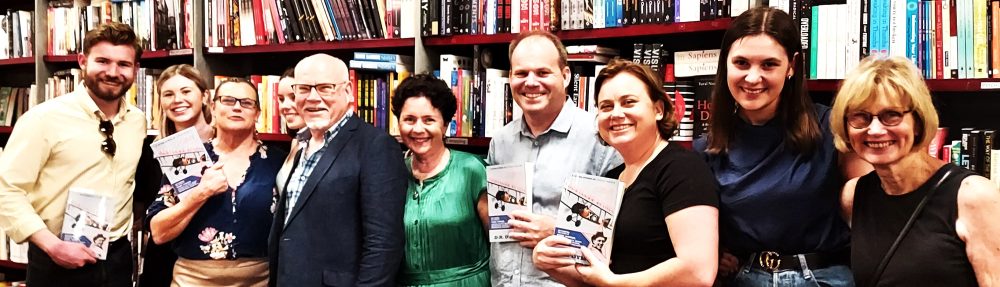
I often wander around bookshops, entranced by the range of titles, but at the same time overwhelmed by the number of authors there are. So to think that soon my book, my name, will be on those shelves alongside (well, close to) some of the world’s best-known authors is mind-boggling. And I have mainly the 2010 Queensland Writers Centre/Hachette Development Workshop to thank for it. Applications are currently being called for the 2013 workshop, and the deadline has been extended to 12 July.
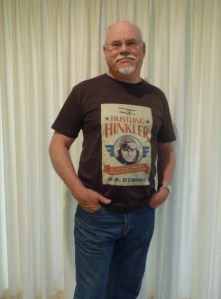
The author in his Hustling Hinkler T-shirt
When I turned up for the first session of that 2010 workshop, I discovered I was the only one there who was a) writing non-fiction, and b) of the masculine gender. The other seven were wrestling with the manuscripts of novels in a range of genres, including crime, reality-based fiction, various sorts of romance and relationships, and speculative fiction (whatever that was). That was a very supportive time, and I’m still in touch with most of my fellow writers, several of whom have since been published.
The funny thing is, that my narrative non-fiction book started life in a different genre – as a young adult novel. I had the rather limited idea that if there was already an existing biography, it wasn’t worth writing another one. So when I re-discovered this intriguing pioneer aviator called Bert Hinkler, I did a lot of research

Author Kim Wilkins
about him, and decided to aim a fiction book at a young adult audience. Keen to develop my craft, I registered for the QWC workshop series with Kim Wilkins, Year-of-the Novel, then the follow-up, Year-of-the Edit. And I learned lots, not only about writing, but about publishing in general.
In that second year, I saw an advertisement for the Writefest event in Bundaberg and, thanks to the ever-obliging Sandy Curtis, had an opportunity to send a portion of a manuscript for consideration by a real, live literary agent, the sort of person who can tell you whether your book is any good or not, and if it is, might find a publisher for it. The agent turned out to be Sophie Hamley, a senior agent with the Sydney literary agency, Cameron Creswell, and the deal was that she’d give each of the budding authors selected, 15 minutes each. The scenario with me went something like this:

Sandy Curtis, author and key figure at Bundaberg Writefest
‘I’ve read the 30 pages of your YA novel,’ Sophie said, ‘and I think it’s got legs, as they say in publishing. I’d like to see the rest of it. Can you please send me the full manuscript.’
When I finished opening and closing my mouth like a goldfish, I managed to say, ‘I’ve been doing a lot of research on Bert Hinkler, and his life story is pretty interesting in itself. I reckon there’s an adult novel in there too.’
She looked straight at me. ‘Why don’t you write his life story?’
‘But there’s already a biography,’ I said.
My dynamic agent, Sophie Hamley
‘When was that published?’
‘1962, with a slight update in 1979.’
‘Might be time for another one,’ she said. ‘Non-fiction outsells fiction three to one in Australia.’
‘Does it?’ I said, eyes wide.
[I know this sounds like bad dialogue from a cheap novel, but that’s how I recall it.]
‘You could write it as narrative non-fiction,’ she said.
Up to this point, I thought there was fiction, non-fiction, and there was politics. What the hell was narrative non-fiction?
Now I do know something about the English language, and my lighting fast brain reminded me: ‘narrative – that means a story’. So I cleverly said, ‘You mean tell a story using non-fiction.’
She nodded, and I nodded in return. ‘Uh huh.’
Sophie must have realised I was scrambling a bit, because she gave me the titles of a couple of big-selling narrative non-fiction books. I carefully wrote the titles down, told her I’d get hold of them, and would immediately begin writing a new biography of Bert Hinkler. And after some pleasantries during which time I tried to show her what a well-read, fascinating writer I am, my 15 minutes was up.
 That was five years ago. Since then, the (rewritten) young adult novel has been highly commended in a publisher’s competition, but is so far unpublished. However, I’ve had two short stories published after being selected in competitions I’ve entered, and, thanks to my agent, Sophie Hamley (see above) I signed a contract with an emerging Sydney e-publisher, Xoum Publications, for publication of a non-fiction e-book in March this year, Extending Your Use-By Date, which attracted heaps of media attention (www.xoum.com.au/shop/extending-your-use-by-date/). I’m continually working on other writing, including another non-fiction book.
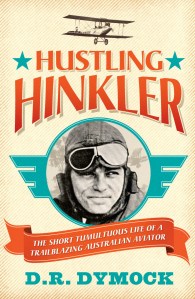
And the biography? It was the one selected for the 2010 Development Workshop, and in August this year Hachette Australia will publish Hustling Hinkler: the short tumultuous life of a trail-blazing Australian aviator. In my next blog post, I’ll tell you about that book and what I learnt on the rocky road to publication.
[re-blogged from Queensland Writers Centre http://www.qwc.asn.au/connect/blog/]
 Bundaberg in coastal Queensland, Australia, to become a world-famous long-distance pilot. On the ground, however, things weren’t always quite so smooth …
 Speaking to the host of the Australian ABC television program, ‘Jennifer Byrne presents’,
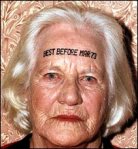 what’s generally known as ‘retirement age’: continue full-time in your current job for as long as you can or want; make a change in your current job (go part-time, work from home); try a different job or start a new business (an encore career); retire, but later go back to work in some form or become a volunteer; or simply retire.
 If it’s within your control, consider in advance what your options are if you continue to work, and prepare for the one you prefer. As you grow older, continually revise your plan (which may only be in your head) to suit your changing circumstances and any change in your thinking.
 Darryl Dymock's Writesite