A question of bias

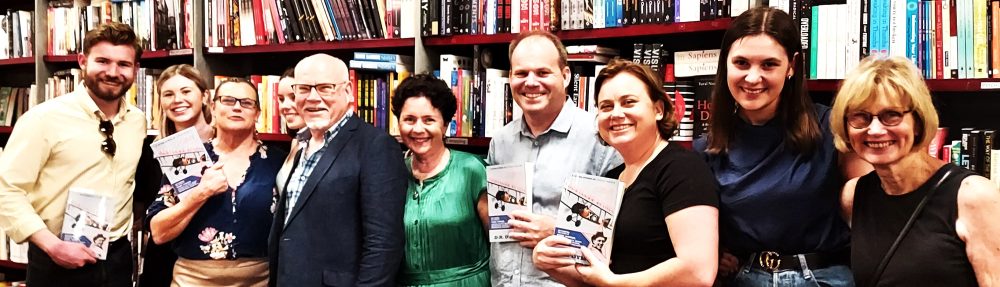
This blog is about two different sorts of bias. The first was in the bowls I was using at the barefoot lawn bowls night organised in Brisbane last week by Hachette Australia, who are publishing my narrative non-fiction biography in August this year. No matter how carefully I aimed my bowls towards the little white ball at the other end of the grassy green sward, they invariably took off on a path of their own. On the one occasion I did roll my bowl so expertly that it ended up nestled lovingly against the white ball, it turned out to have strayed into the game on the next rink.

Lawnbowls

The only consolation was that no one else seemed much good at the game either, including Hachette’s Publishing Director, Fiona Hazard, and the new Sales and Marketing Director, Justin Ratcliffe. The informal occasion was a fun way to meet local booksellers and some of the other important Hachette people, including the reps. I was also glad to catch up with my former workshop tutor and prolific author, Kim Wilkins, and with Charlotte Nash, fellow-writer from the 2010 Queensland Writers Centre/Hachette Development workshop, whose book, Ryders Ridge, will be launched in Brisbane on 9 April.

The other case of bias is more serious. It is the discrimination shown by employers towards mature-age workers. Among older people seeking work in Australia, over a third of men and more than a quarter of women say they are considered too old by employers. The Human Rights Commission quotes research that found older people in advertisements are often portrayed as ‘bumbling, crotchety or senile’. In the workplace, generalising and stereotyping on the basis of age can see young people preferred because they are perceived to be more efficient (and possibly more compliant) than older people, who are regarded as less productive and high risk, even though more experienced. ‘The overriding message for older workers,’ says the Human Rights Commission, ‘is a one-way ticket to certain decline.’ ageism

Age discrimination is one of the topics in my E-book, Extending Your Use-By Date: Why Retirement Age is Only a Number, to be published in March by Xoum Publications.

One of the potential outcomes of such discrimination is that mature-age workers may begin to believe the myths, which therefore become self-fulfilling. Those who feel marginalised or unable to obtain a job because of their age may also suffer from stress, cognitive decline, depression, social isolation and sometimes a reluctance to get out and do things. Loss of self-esteem is a powerful demotivator.

We need to resist someone else telling us when we’ve reached our use-by date. As the Hachette bowling night demonstrated, ability mostly has nothing to do with age.

The Next Big Thing

As part of a writers’ fun networking exercise, I was tagged by author Dawn Barker to take part in The Next Big Thing, a ‘chain blog’ for writers. Anxious to avoid any repercussions for breaking the chain (shiver), I’m using the template below to answer some questions about my book. You’ll see at the end that I’ve tagged another writer I’ve met along the way who will do the same next week.

1. What is the working title of your next book?

My first e-book, Extending your use-by date: Why retirement age is only a number, will be published in March 2013.

2. Where did the idea come from for the book?

400,000 Australians aged 45 or more don’t know when they’ll retire and 650,000 say they’ll never retire.  Those are figures from the Australian Bureau of Statistics I stumbled upon when doing research in my part-time role at Griffith University. As one of those who is currently part of the 650k, I was fascinated that so many were planning to continue working past ‘traditional’ retirement age.  That didn’t seem to be the conventional wisdom.

What’s more, many of them said they weren’t doing it for the money – or at least not only for the money. At the same time, I noticed there are lots of books in the bookshops about planning for retirement, but hardly a word on planning not to retire. Hence this book.

3. What genre does your book fall under?

Non-fiction, because it’s based on research. I’ve talked to dozens of people in their 60s and 70s who are still in paid work or serious volunteering, and collected other examples from across the world. I’ve also drawn on predictions about ageing populations and emerging job needs, as well as on scientific research that separates myth from reality about physiological and cognitive ageing.

But it’s by no means an ‘academic’ book. It’s meant for a general audience aged from their mid 40s upwards, and I’ve used all my recent experience in developing narrative non-fiction to make sure it’s a book people will enjoy reading. Not to mention the cartoons …

4. What actors would you choose to play the parts of your characters in a movie rendition?

Extending your use-by date would make a great doco. In Australia, oldies like Jack Thompson, Quentin Bryce, Malcolm Fraser, Bob Hawke, Maggie Tabberer, and Lindsay Fox could play themselves. There’s no shortage of stars and extras for a ‘reality’ show.

However, you could also develop a terrific screenplay around the book’s theme (see next question).  A movie you’d come out of feeling good about. Judi Dench, Sean Connery, Michael Caine, Helen Mirren, Morgan Freeman, Jack Nicholson, Jane Fonda, George Clooney

5. What is the one sentence synopsis of your book?

We sometimes head unthinkingly into retirement at a time when we’re living longer than ever and we have developed skills and abilities we can keep on using. Also, continuing to work can maintain our wellbeing as well as contribute to our bank balance.

6. Will your book be self published or represented by an agency?

Extending your use-by date will be published in March 2013 by an emerging Australian e-publisher, Xoum Publications. I am represented by the very experienced Sophie Hamley from Cameron Cresswell Agency.

7. How long did it take you to write the first draft of the manuscript?

It took about a year to do the initial research and begin structuring the book, and another twelve months to finish writing the first draft.

8. What other books would you compare this story to in your genre?

I regard it as filling a gap, so there’s nothing to compare it directly to. But it should inspire working people looking for direction in the later part of their lives.

9. Who or what inspired you to write this book?

In addition to the insight I’ve described in response to Question 2, the inspiration came from my own experience as an ‘older worker’ and a belief that we can continue to learn, grow and contribute to the society in which we live for longer than many people think.

10. What else about the book might pique the readers’ interest?

Because this book is a collection of people’s personal stories and tips about working into older age, it has a very human element I know readers will relate to. And some people already want to read the summary of research about what we should expect in the way of physiological and cognitive decline as we get older. Not to forget the cartoons …

Thanks for the tag, Dawn. To make sure the chain isn’t broken, I’m tagging Heather Garside to answer these ten questions for next time. Heather has some exciting news to share.

e-book contract signed for Extending your use-by date

Grab your Kindle and get ready to download. I’ve just signed a contract to have a non-fiction manuscript published, this time as an e-book.

In March 2013 you can check the electronic bookstores for Extending your use-by date: Why retirement age is only a number. It will be published by Rod Morrison and the team at an emerging Australian e-publisher, Xoum Publishing, www.xoum.com.au

Signing the Xoum contract

My agent, Sophie Hamley, sent them the manuscript, they liked it, and now we’re working together to prepare it for publication and promote it to potential readers.

Xoum is a Sydney-based independent multi-media publishing company, founded by publishing and design professionals, David Henley, Jon MacDonald and Rod Morrison. They say they use the most up-to-date production technologies combined with traditional editorial, sales and marketing nous. Xoum titles are distributed globally via Amazon, the iBookstore, Kobo, Overdrive and Google Play.

The starting point for Extending your use-by date is that we sometimes head unthinkingly into retirement at a time when many of us have developed skills and abilities we can keep on using and when people are generally living longer. It also argues that continuing to work can maintain our well-being as well as contribute to our bank balance. But only if we want to.

So, I’ll have two books out in 2013: Extending your use-by date as an e-publication in March (Xoum* Publishing), and the biography of aviation pioneer and global adventurer Bert Hinkler in hard copy in August (Hachette Australia).

* pronounced ‘zoom’ of course