A boulder for a bold pilot

A boulder from a Queensland beach is now resting on the side of an Italian mountain, as a memorial to the trail-blazing Australian aviator, Bert Hinkler.

Regular readers of this blog will know that I wrote a biography of the famous pilot, Hustling Hinkler, which was published by Hachette in 2013.
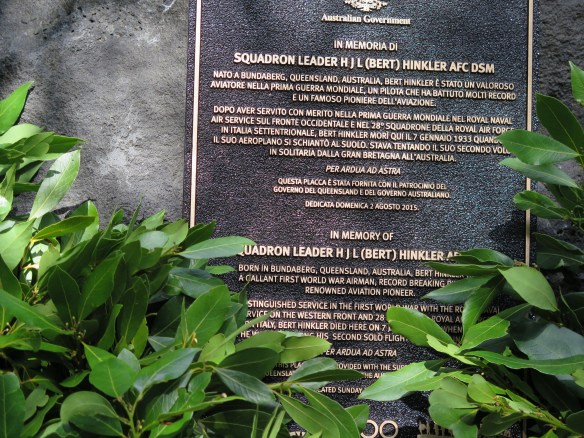
Bert Hinkler Memorial, Mt Pratomagno, Italy

Bert Hinkler Memorial, Mt Pratomagno, Italy

Australian Ambassador to Italy, Mike Rann, recently unveiled the memorial on the slopes of Mount Pratomagno, in Arezzo Province.

Hinkler lost his life when his single-engined Puss Moth monoplane crashed on the mountainside in April 1933, during his second attempt on the England-Australia solo record.

The local Italian community and aero club paid tribute to Hinkler at the time as a pioneer international aviator, and Mussolini’s Fascist government accorded him a spectacular State funeral through the streets of Florence.

Bundaberg Aero Club memorial at Hinkler Ring, Italy

Bundaberg Aero Club memorial at Hinkler Ring, Italy

So it is fitting that the Australian, Queensland and Italian governments should unite in support of a memorial to the gallant flier at the place where he crashed.

The boulder is now a feature of an eight-kilometre long mountain trekking path, called The Hinkler Ring, inaugurated by the Italian Alpine Club’s Arezzo Branch.

The memorial was the brainchild of Queenslander, Kevin Lindeberg, who met one of the finders of Hinkler’s crashed plane, Gino Tocchioni , in 1974, and so knew where the crash site was.

Bundaberg City Council arranged for the 1.4 tonne basalt boulder to be transported to Italy from Mon Repos Beach, where Bert Hinkler first flew, in 1912, in a glider of his own design.

Hinkler Ring Memorial Walk. Italy

Hinkler Ring Memorial Walk. Italy

A time capsule buried in the base of the monument includes letters from the recently deposed Australian Prime Minister Tony Abbott and Queensland Premier Annastacia Palaszczuk. About 200 people attended the August ceremony, including Australian, British and Italian dignitaries, and Hinkler’s great nephew John Hinkler.

Here is an extract from the Prologue to Hustling Hinkler, the only piece of ‘creative’ non-fiction in the book, about Bert Hinkler’s final flight, in April 1933:

When he passed over the city of Florence around 10 am local time, he was already behind the schedule he’d mapped out. By now he’d been in the air for seven hours, and he was weary from the drone of the engine and battling the elements. Hinkler wished he’d been able to leave London three months earlier, as he’d originally intended, when the weather – and Air Ministry officials! – might have been kinder to him.

He could see cloud on the mountains distantly ahead, and the thought of diverting to Rome attracted him for a moment, but just as quickly he dismissed the idea – any diversion would mean less chance of breaking the record, and his future depended on achieving that goal. He continued south towards Brindisi. As soon as he’d made the decision to go on, patchy cloud began to snatch at the cockpit, and he could feel the cold drilling deeper into his bones. Sharp fingers of wind continued to push and pull at the plane, and for a moment Hinkler wondered if he sensed another tremor through the wings, but dismissed the thought as he wrestled with the controls.

Up ahead, through the clouds, he glimpsed the snow blanketing the Pratomagno mountains. He knew the highest point of the range, the Croce del Pratomagno, the Cross of Pratomagno, was just over 5000 feet, but that held no fears for him – after all, he’d crossed the much higher Italian Alps earlier in the day. Just so long as the winds were not too violent, and the plane held together . . .

Till next time

Darryl Dymock


What writers say:

Political language is designed to make lies sound truthful and murder respectable, and to give an appearance of solidarity to pure wind. ~ George Orwell

Input vs Output for Writers

The Brisbane Writers Festival (BWF 2015) is over for another year. I was fortunate to be able to get to a couple of the sessions on the Thursday and Friday – a masterclass withBWF-2015 US short story writer, Kelly Link, and another with researcher and biographer, Karen Lamb.


Kelly Link introduced us to The Family Arcana: A Story in Cards by Jedediah Berry. It’s described as ‘a story about a haunted family, published as a poker deck and written to be read an infinite number of ways’. Kelly’s deftness in shuffling this pack indicated either that she spent her childhood in Las Vegas or that she has a fall-back position if she ever tires of writing. One member of the masterclass asked her about the appropriate length of a short story. Kelly said she’d recently written a 14,000-word story, and one of her writing colleagues consequently suggested it

Author Kelly Link

Author Kelly Link

was time she thought about writing a novel…

I bought a copy of Kelly’s latest book of short stories, Get in trouble (Text Publishing, 2015), and when she signed it she warned me that the stories had ‘pretty weird endings’. I’m looking forward to reading it.

I have a few things in common with Karen Lamb – she’s a researcher and biographer, she teaches at a university in Brisbane, and she likes structure in her teaching. So she had a timetable for the masterclass. The value of the class for me was that it gave me new insights into my current draft about the ‘Chalkies’ in Papua New Guinea 1966-73 (see previous blog). Also, Karen mentioned a book by an American writer, the intriguingly named Francine Prose, Reading Like a Writer (Harper Collins, 2006), described as ‘A guide for people who love books and for those who want to write them’, which could be worth a look. I bought a copy of Karen’s biography, Thea Astley: Inventing her own weather (University of Queensland Press, 2015), because I’m interested to see how she wrote it, and I also like supporting fellow writers as well as an independent bookshop (State Library of Queensland).Thea Astley biog

There were other potentially fascinating sessions at BWF, but apart from having family commitments over the weekend, I also reach a point at such events where I need to get back to my own writing rather than continue to hear other writers talk about theirs. I strongly support the adage that the best thing a writer can do is write! As a long-time educator as well as writer, I believe external input, whether through writers’ festivals, self-help guides or online tips, can be very helpful, especially if it’s timely, but it can also be an excuse for procrastination.

Book review

I thought I’d share with you my response to a book my wife gave me for my birthday: Between you and me: Confessions of a comma queen by Mary Norris (Text Publishing, Melbourne)

Mary Norris is a copy-editor at the well-known The New Yorker magazine, which publishes news stories, short stories, essays, cartoons, poetry, etc, and includes an audience well outside its host city. It’s also well-known, if not notorious, for its rigorous copy-editing, and Mary Norris is one of the enforcers.

new-yorker-magazine

This non-fiction book is part memoir, part discussion of points of punctuation and grammar, often humourously expressed, and sometimes self-deprecating. Nevertheless, there are clearly standards of English expression to be upheld, and Ms Norris shows she believes has a responsibility as a standard-bearer. She does not brook the use of dangling participles, for example, once objecting to this construction from an author: ‘Over tea in the greenhouse, her mood turned dark’, and she rejects outright the use of ‘their’ in place of ‘his and/or her’. Mary Norris also uses only No. 2 pencils for hard-copy editing and if someone accidentally leaves a No. 1 pencil on her desk and she picks it up, she knows immediately it is not hers, and throws it in her desk drawer.  Part of her story is about being able to find a reliable supply of No. 2 pencils.  You get the picture.

In between, the author gives us a fascinating insight into the backrooms of The New Yorker and her fellow editors, including Lu, who ‘patrolled the halls like a prison warden’. On Lu’s desk sat a small canister she called a ‘comma shaker’, to express her distaste for what she saw as The New Yorker’s over-use of commas.

Between you and me: Confessions of a comma queen is an enjoyable read, and some of Mary Norris’s punctuation examples are guaranteed to provoke discussion among people who care about the use of language. I just hope she doesn’t run her No. 2 pencil over my blog.

Until next time

Darryl Dymock